
Turning disaster into opportunity
When PM Modi spoke those words on May 12, 2020, everybody thought he was referring to the COVID-19 situation
at that time.
All of us, including myself, forgot the PM’s words as COVID-19 passed and became a thing of the past.
Never in my wildest dreams did I think the PM was referring to every crisis, irrespective of the past, present, or future.
He was incredibly serious during COVID-19, and even more so during the Iran/US crisis over the last 3-4 months.
We have discussed in past articles how crude oil prices spiked during the crisis, and how difficult it was to procure
crude oil even at those inflated prices.
There were rumors that the crude prices quoted during the Iran crisis were lower than the actual prices at which
crude was available.
Factoring in crude oil prices, price premiums, and shipping freight carrier charges, unofficial sources indicated that
the Indian crude oil basket was around $160 per barrel, while Brent crude was trading at around $120.
India was paying this premium to maintain stability in its domestic market without passing the price increase on to
domestic and commercial consumers.
India faced crises in many sectors, including aluminum, fertilizers, etc.
We are focusing only on the oil sector here, as it is the most sensitive sector.
India was in a deep financial crisis during that period because there were two main targets:
1.Get the product from anywhere.
2. Get the product at any cost.
This two-point agenda resulted in Indian oil companies suffering a net cash loss of $8-9 billion.
This is a massive hit to their balance sheets and future expansion plans.
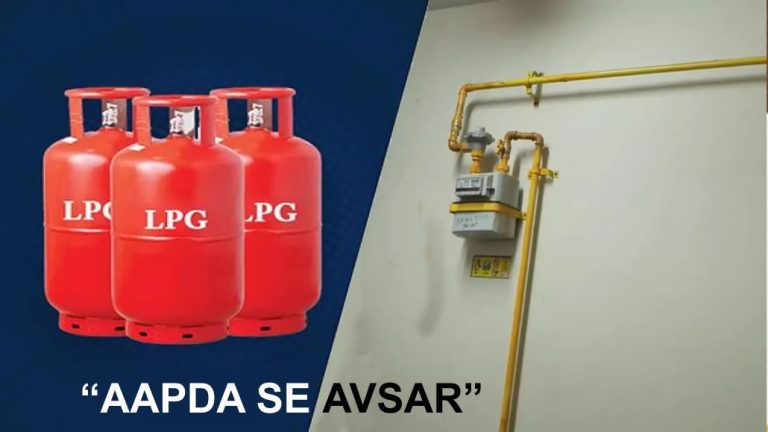
Now, this represents the first part of the PM’s statement: “aapda” (crisis).
Here is how this was turned into a long-term, permanent opportunity that will save oil companies and the government
approximately $2-3 billion every year.
The government took a few drastic steps in the last few months which went almost unnoticed but will have a huge
impact:
1. A government order dated March 25, 2026, for the ” Natural Gas and Petroleum Products Distribution
(Through Laying, Building, Operation and Expansion of Pipelines and Other Facilities) Order, 2026.”
This act provides a time-bound framework for laying and expanding pipelines across the country, addressing
delays in approvals and land access, and enabling the faster development of natural gas infrastructure,
including in residential areas.
A) Permissions are granted on a default mode.
B) Deadlines are strictly deemed.
C) Penalties are in place for delays.
2. National PNG Drive 2.0 Extended Until June 30.
Key Highlights:
▪ Over 80,400 consumers surrendered LPG connections through MYPNGD.in.
▪ 8.82 lakh PNG connections have been activated since March.
▪ Infrastructure has been created for 11.80 lakh potential PNG connections.
▪ 8.98 lakh consumers have registered for new PNG connections.
3. No dual connections of LPG and PNG are allowed.
4. No new LPG connections are issued where PNG pipelines are available.
5. Mandatory shift to PNG.
6. E-KYC/Aadhaar verification of all LPG connections (98% achieved).
7. OTP-based LPG cylinder delivery (95% achieved).
8. PM Ujjwala subsidy refills have been reduced from 9 to 4 per year, curbing diversion.
9. The refilling period was changed from 25 days to 45 days (no official record).

2.5 lakh PNG connections were activated in March.
From March to June 2026, a span of four months, almost 8 lakh new PNG connections were added.
In 2024 and 2025, there were 10 lakh new PNG connections each year.
This is how we convert a crisis into an opportunity.
This is how we plan to save in the long term.

India currently has 33.3 crore LPG connections.
Of these, 10.43 crore fall under the PMUY (Pradhan Mantri Ujjwala Yojana), which sees very low demand for refills.
India plans to reach 20 crore PNG connections by 2030, which is quite ambitious.
This is true both in terms of the number of connections and the required infrastructure setup.
We will discuss the bottlenecks, along with the pros and cons of PNG, in the next article.