In continuation of our earlier part, let’s do some maths with facts and figures on F&O.
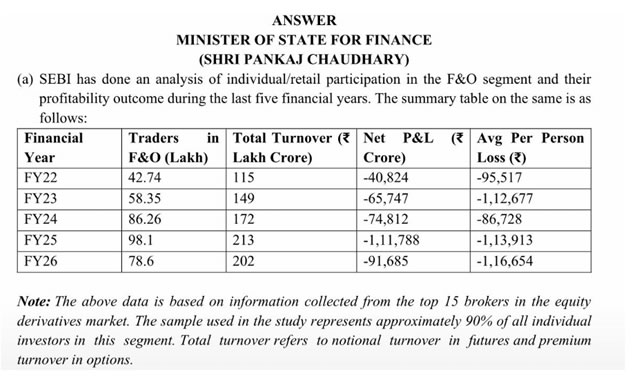
The details below are real, because they were submitted by the government in the Lok Sabha.
The Lok Sabha is the highest law-making body in India, so any document presented here comes with full
truth and facts.
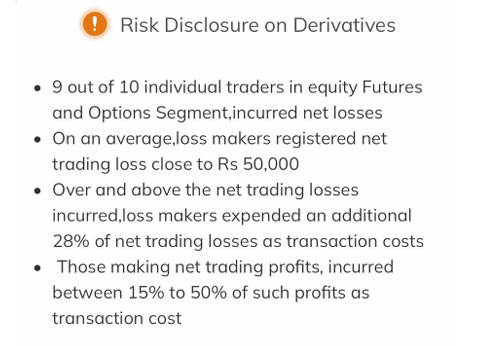
It says 90% of retail investors are in loss, and the losses run into thousands of crores.
₹91,000 crore was lost in one year. That’s exorbitant.
The loss per person has been on the rise.
Now, the next question is:
If individuals and common people lost ₹91,000 CRORE, then somebody must have gained ₹91,000
CRORE.
It’s the simple balance sheet rule: debit/credit, profit/loss.
If we break down the division of the ₹90,000 crore profit, two parties took it:
1. The Government of INDIA, as charges and income tax on profit
2. FIIs/DIIs/HNIs
The government gaining through charges/taxes is understandable, as we all know, “The house always
wins.”
The question is why and how big financial institutions keep making profits while retail investors keep
losing.
How is this possible? What can they see or calculate that others cannot?
I think it’s not possible unless you either have information or are manipulating the market.
The calculation below explains how F&O profit and loss works:
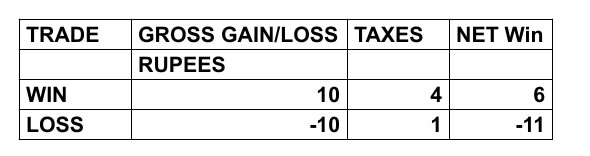
If we make a gross profit of ₹10, we take home ₹6 and the government takes ₹4.
If we make a gross loss of ₹10, we take home ₹0 and the government still takes ₹1.
The investor bets ₹10 but loses ₹11, and that too 2 out of every 3 times he bets.
By the simple rules of gambling/probability, the chance of any outcome should be 50/50.
But if we apply the profit and loss figures, the win rate we need just to break even comes to 64.7%.
So technically, you have to win 2 out of every 3 bets you make in F&O.
It’s far worse than betting in Las Vegas.
If you win less than 2 out of 3, you will be paying from your own pocket.
So financial institutions beating all the odds of probability is really not justified.
The government has tried, and keeps trying, to cut the losses of F&O retail traders.
But it’s not working. Neither the total loss nor the loss per person is reducing.
The government cannot stop F&O trading because:
1. The government is minting money by doing nothing; it’s free income.
2. If the government stops it, people will trade illegally and unofficially.
The more the government pokes its head in, and the more it tries to control and audit financial
powerhouses, the more money will move out of India.
We have seen a net outflow of funds from India.
The more funds move out, the more the market will keep suffering.
The more the market suffers, the more even long-term investors and mutual funds will suffer.
Now it’s a matter of discussion whether we need FIIs, as everybody in the market is crying out to bring
FIIs back to the Indian market.
It looks like a vicious cycle.
One thing is sure: there is no level playing field. This gambling game is not following any rules, because:
1. The probability of making money is around 35%.
2. The share of common individuals making money is 10%.
3. Market information is biased.
Individuals should sit outside and watch the elephants fight. Do not prove the phrase right:
“When elephants fight, it is the grass that gets trampled.”