
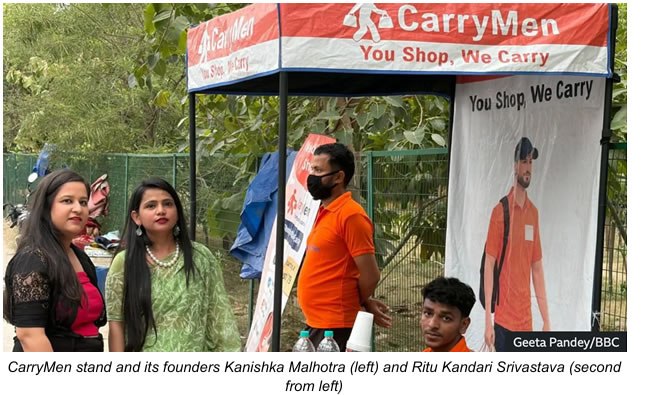
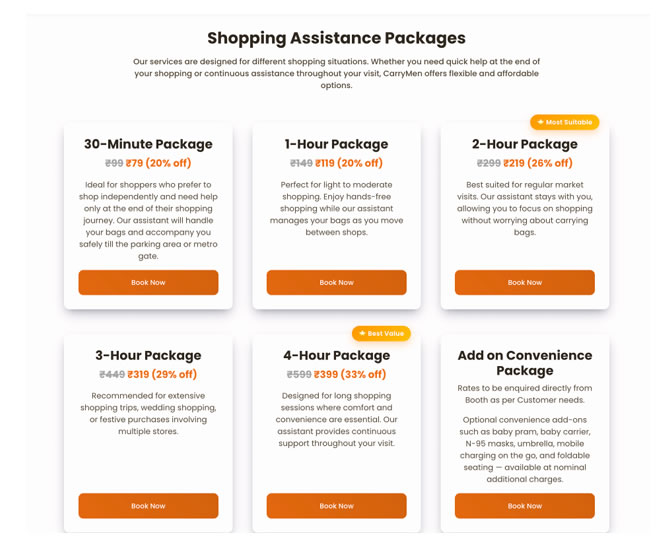
CarryMen is a Delhi based hyperlocal assistance startup operating in Lajpat Nagar Market. Its core proposition is that shoppers can hire a trained assistant to carry their bags, wait in queues, help them move through crowded lanes, and guide them to parking or metro points. The service has been reported at around ₹149 per hour, with
shorter and longer packages also available.
At the surface level CarryMen looks like a bag carrying service. However, technically it is better understood as a last 100 metre retail infrastructure startup which focuses on optimising the final interaction between consumers and sellers. Unlike food delivery or e-commerce logistics, which move goods from store to home, CarryMen operates inside the physical shopping journey. It solves the problem of fatigue, crowd navigation and fragmented movement within high-footfall markets.
CarryMen’s current model depends on three core operating layers. –
First, there is the customer access
Customers discover the service through a booth, website, social media, or WhatsApp. The booking is time based rather than task based, which makes pricing easy to understand. A customer does not pay separately for each bag or
each queue, they pay for the assistant’s time.
–
Second, there is the workforce layer.
Assistants are deployed inside the market and assigned to customers for fixed time slots. This requires training, identity verification, uniforms, basic etiquette, and clear behavioural standards. Since the assistant physically accompanies the customer, trust is a much bigger factor than in a normal delivery model. Third, there is the market control layer.
CarryMen has to manage real-world variables such as peak-hour crowds, assistant idle time, weather, customer wait time, worker fatigue, and location based demand. In a market like Lajpat Nagar, demand is likely to rise during
weekends, festive seasons, wedding shopping periods, and evening shopping hours.
Unit Economics
When under criticism of exploiting workers, co-founder Ritu Kandari Srivastava stated that all their workers were full time employees and not gig workers. Therefore, CarryMen’s commercial viability strongly depends on how efficiently each assistant’s available time is converted into paid customer time. This means that the key metric is
not total footfall in the market, but billable utilization i.e., the percentage of an assistant’s shift that is actually monetized
For example, assume one assistant is deployed for an 8 hour shift in Lajpat Nagar. If the assistant is booked for 3 hours, utilization is:
(3 ÷ 8) × 100 = 37.5% utilization
At ₹149 per hour, this produces
₹149 × 3 = ₹447 daily gross revenue
However, if the same assistant is booked for 6 hours within the same shift, utilization rises to:
(6 ÷ 8) × 100 = 75% utilization
This produces:
₹149 × 6 = ₹894 daily gross revenue.
On a 26 day working month basis, the difference is significant:
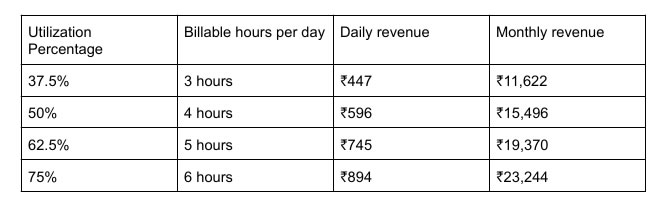
This shows that CarryMen’s model is highly sensitive to utilization. A 37.5% utilized assistant may not generate enough revenue to cover wages, uniforms, supervision, booth costs, marketing, technology, and administrative overheads. But a 75% utilized assistant creates a much stronger path toward operational sustainability.
The business therefore needs to optimize around variables such as:
1. Demand density: enough customer bookings in a limited geography.
2. Assistant allocation : placing assistants at high-conversion locations such as metro exits, parking points, food lanes and ethnic-wear clusters.
3. Session efficiency : reducing idle time between bookings
Unlike app based delivery models, CarryMen does not benefit from long distance order aggregation. Its geography is intentionally compact. This can be an advantage because assistants can complete multiple short bookings in the same market without travel downtime. However, it also means the company must predict micro demand patterns
very accurately. Demand may spike during weekends, wedding seasons, festive periods and evening shopping hours, while weekday mornings may have low utilization.
A stronger revenue model may therefore combine hourly pricing with add-on services. For example, the base rate could remain ₹149/hour, but the company could charge small add-ons for priority assistance, senior-citizen assistance, group shopping help, or wedding-shopping packages. This would increase the average revenue per booking without necessarily increasing the assistant’s working hours. A few of these add ons can already be seen on the company’s website which include baby prams, masks, umbrella support etc.
Discussion
The viral conversation around CarryMen often frames it as a convenience product for people who do not want to carry bags. But the stronger customer segments are more practical.
The service is useful for elderly shoppers, pregnant women, parents with children, people recovering from injury, solo shoppers carrying bulk purchases, tourists unfamiliar with Delhi markets, and customers doing wedding shopping. In these cases, the value is not luxury, it is reduced physical strain and smoother movement through an
overcrowded retail environment.
This is important for positioning. If CarryMen presents itself only as “someone to carry your shopping bags,” it risks being seen as frivolous or classist. If it positions itself as a structured shopping-assistance and accessibility service, the value proposition becomes stronger and more defensible.
Lajpat Nagar is a suitable pilot market because it has dense footfall, fashion-led shopping, heavy bag accumulation, metro access, narrow lanes and limited resting infrastructure. Similar markets in Delhi NCR could include Chandni Chowk, Sarojini Nagar, Karol Bagh, Janpath, Rajouri Garden and Kamla Nagar.
However, CarryMen cannot scale like a normal app-based startup. Each new market requires local permissions, worker deployment planning, customer trust-building, kiosk placement, crowd understanding and possibly coordination with market associations. Expansion is therefore likely to be market-by-market rather than citywide from day one.
Conclusion
CarryMen is more than a viral Delhi startup. It is an attempt to formalize a missing convenience layer inside India’s crowded physical retail markets. Its success will depend on utilization, trust, worker management, pricing discipline and market-level execution. The model is easy to imitate, so its defensibility will come from reliable operations rather than the idea itself.
If CarryMen can combine trained assistants, simple booking, transparent pricing and ethical labour practices, it has the potential to become a scalable hyperlocal retail-support service across India’s busiest shopping districts.