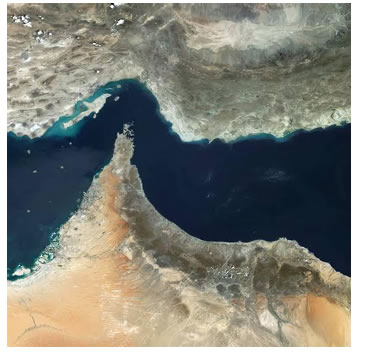
The Strait of Hormuz is one of the most strategically important waterways in the world. Its significance dates back thousands of years, involving civilizations such as the Sumerians, Persians, and the Indus Valley civilization. Along with its importance, the region has also witnessed long-standing conflict and repeated attempts at control.
Recent recorded history includes:
● The Portuguese conquest (1500 AD)
● The Anglo-Persian conflict (1622 AD)
Historically, the Persian Gulf was a major trade hub connecting India and China. With the discovery of oil, its importance increased significantly.
It is now considered one of the world’s most strategically important trade choke points.
1. The Strait of Hormuz : a global choke point for energy supply
○ Connects the Persian Gulf to the Arabian Sea
Other major global trade choke points include:
2. The Panama Canal
3. The Suez Canal
4. The Strait of Malacca
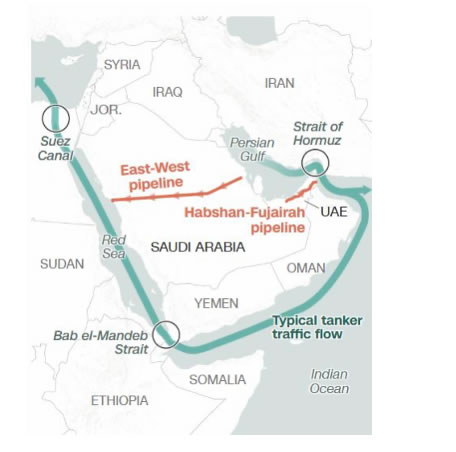
If we look at the map below,
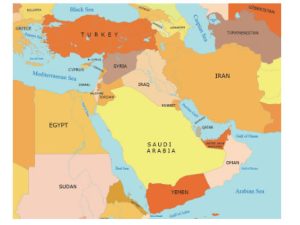
Key Countries Around the Strait:
– Iran
– Iraq
– Kuwait
– Saudi Arabia
– Qatar
– UAE
– Oman
These countries account for ~20% of the global oil & gas supply.
Current Scenario (March 2026 Conflict)
Crude oil prices increased from $60 to $100 per barrel (approximately a 66% rise). Prices have remained elevated for over a month. The situation appears to be driven more by market panic and media influence than by an actual
supply collapse
I estimate a correction range of $75–85 per barrel once the conflict slows down. I am also guessing that after 5–7 years, the range would still be lower, as this is the first time Iran has actually fired warheads along the Persian Gulf countries, damaging their oil wells, pipelines, cargo, and, most importantly, refineries.
The price range of crude is based on the following observations:
● Iran is exporting at higher levels than in the pre-war period
● Saudi Arabia is using the East-West pipeline
● The UAE is using alternative pipelines
● Oman remains unaffected
● Iraq is exploring the Syria route
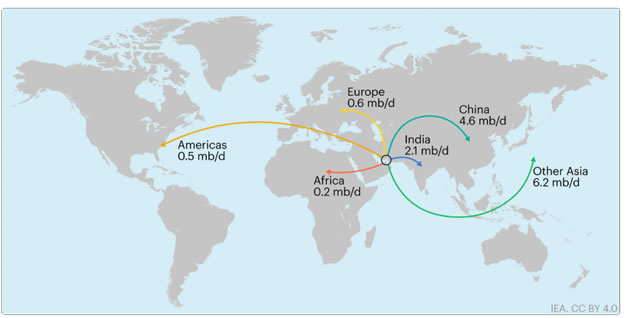
● India and China continue imports
Most affected supplying countries are
– Kuwait
– Qatar
Most affected purchasing countries are
-Europe
– Japan & Korea, southeast Asia
Shipping & Logistics Bottlenecks
● Normal traffic: ~130 ships/day
● Current traffic: ~15–20 ships/day
● This has resulted in 1,000 tankers being stuck
● Global tanker shortage
● New or alternate supply locations such as Russia, Africa, and South America will
increase shipping distance and, therefore, costs
The Strait of Hormuz is selectively open.
Iran can export to any country.
India and China can import from any Persian Gulf country.
However, everything is based on Iran’s management, which is a bit complicated and similarly
unpredictable.
This is happening because they lack communication in Iran.
Iran is presently divided between the political side and the army side (IRFC).
The army itself seems to be divided, and there is a lack of chain of command.
The deaths of top leaders from both the political and army sides have created a vacuum and
silos.
This is evident from the fact that even ships from China, which fully support Iran, are finding it
difficult to cross the Strait of Hormuz.
This war will change many things. It will leave scars on the Persian Gulf countries and shape
their future thinking.
We will discuss what could happen to the Persian Gulf and the world once the dust settles from
the present conflict.
The current stalemate is quite complicated, fragile, confusing, and marked by mistrust.
Nobody knows who is making the agreements, and nobody has control on either side.
We will see how it works..
(To be continued in Part 2)