Three important developments related to rare earth elements (REE) occurred for India in November 2025.
1) G-20 Summit, 22–23 November 2025, Johannesburg, South Africa
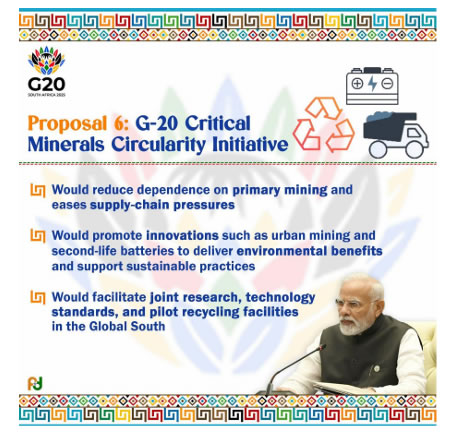
Proposal No. 6 at the summit was particularly notable. It focused on Critical Minerals (Rare
Earth Minerals) and emphasized the following circularity initiatives:
a) Reducing pressure on primary mining
b) Promoting urban mining
c) Encouraging joint research on recycling among Global South nations
2) Indian Government Approval of ₹7,280 Crore (~1 Billion USD) for Domestic Rare Earth
Manufacturing
This is a major step forward for India because despite having sufficient rare earth deposits to
meet most of its priority-sector demand, India currently imports almost 100% of its rare earth
requirements
3) Clearance of Long-Pending Investments by BYD, MG, and VinFast in India
The importance of this decision lies in the fact that all three companies possess significant rare
earth resources.
Their entry will support the growth of India’s EV sector by ensuring a smooth supply of rare
earth magnets through in-house production or imports from their home countries therefore
avoiding bottlenecks in the value chain.
These developments in the same month show how serious the rare earth mineral issue is and
how India is taking proactive action in real time to secure her future.
CYCLIC MATERIALS (Canada) is a leading company in rare earth recycling. According to their
published research:
1. Only 1% of rare earth elements are currently recycled globally.
2. Magnets account for 30% of total rare earth usage.
3. McKinsey projects global rare earth demand to grow from 59 kilotonnes in 2022 to
approximately 176 kilotonnes by 2035 which is nearly threefold.
These statistics show that both mining and recycling will have strong markets for decades.
Recycling REEs is nearly as complex as mining them.The quantities present in most electronic
devices are very small and difficult to separate from other materials.
For Example:
A single EV motor contains around 550 grams of rare earths.
An F-35 fighter jet contains approximately 400 kg of rare earth materials (in a 15,000 kg
aircraft).
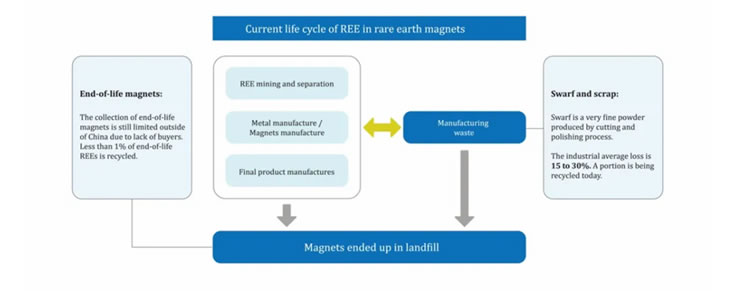
A simplified chart of the magnet life cycle is shown below:
approach to REE recycling is guided by four key objectives:
1. Environment
2. Economics
3. Employment
4. Energy Efficiency
Tusaar Corp has unveiled a rare earth recycling plant with an initial capacity to process 4,000 kg
of magnets per day.This volume alone can supply nearly 10% of the U.S. rare earth demand
through the recycling loop.
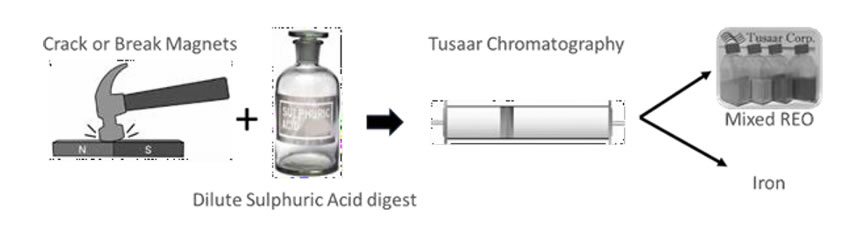
Their efficient process involves:
● Mechanical breaking of magnets
● Acid dilution
● A patented chromatography technique
● Separation and recovery
Many more companies are working in the rare earth recycling field. For example:
1. Cyclic Materials
2. Attero Recycling (India)
3. Rare Earth Salts
4. Hitachi Metals
5. Global Tungsten & Powder Corporation
6. Osram
7. Solvay SA
8. Umicore
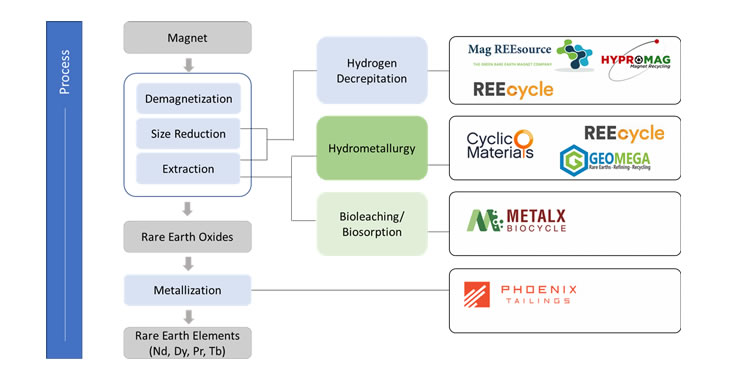
The chart below outlines brief descriptions of REE recycling processes and the techniques used
by leading companies.
Many more recycling companies will enter production, creating a closed-loop circular
ecosystem.
2. EV sales growth will stabilize rather than grow exponentially.
3. Alternatives to rare earths for magnets and batteries will emerge.
We are already observing a slowdown in sales of EVs and solar panels due to oversupply and
price pressure. It’s not that the Rare earth demand will not disappear, but it will stabilize.
The global balance of power will shift and no single country will dominate the REE market
indefinitely.China’s control over rare earths is expected to diminish over the coming decade as
alternative materials emerge.
EVs and consumer electronics are price-sensitive sectors, and prices cannot rise indefinitely. A
more balanced, diversified global rare earth supply chain is taking shape.